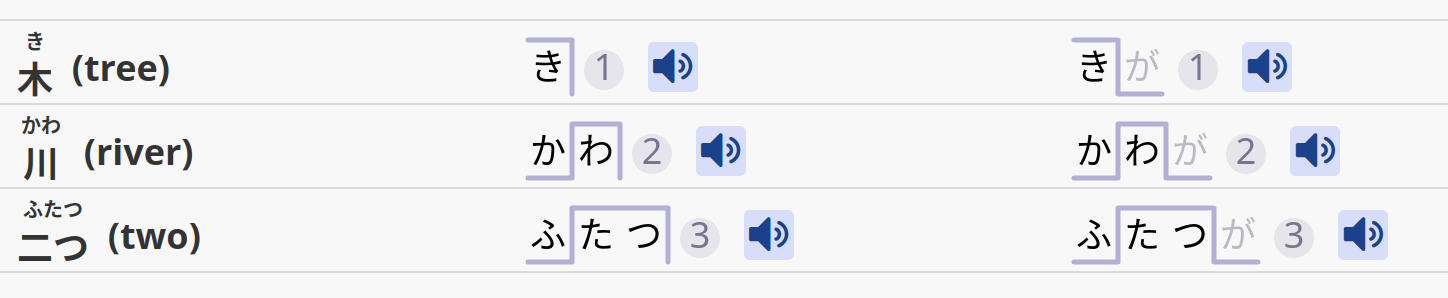
Japanese has a tonal system. Depending on how you change the pitch, you can change the meaning of a word. There are 4 main patterns:
| | 平板 | 頭高 | 中高 | 尾高 | | ----------------------------------- | ---- | ---- | ---- | ---- | | Starts | low | high | low | low | | Center is | high | low | high | high | | Word ends | high | low | low | high | | particle is | high | low | low | low | | One letter words | ○ | ✕ | ✕ | ○ | | particle accent in one-letter words | | | | | tl:dr:
- 平板↔頭高
- 中高 = 尾高 where pitch drops somewhere in middle of word.
- single mora 尾高 is high-low
平板
{平板|へいばん} is the 'accentless', flat-ish profile.
About 70% of all japanese words are heiban.
The first mora is low, all following are high.
The particle following is also high.
 Youtube: Yudai Sensei - Mastering Heiban
頭高
{頭高|あたまだか} is the 'head high' pattern.
The first mora is high, all following are low.
The particle is also low.
It is the exact opposite of the 平板.

中高
{中高|なかだか} has the middle high.
The first mora is low. The pitch rises after, but it drops again somewhere in the word.
The particle is low.

尾高
{尾高|おだか} has the tail high
The first mora is low, except if the word only has a single mora. For single mora, it is identical to 頭高
The pitch rises after the first mora.
At the particle, the pitch drops again.